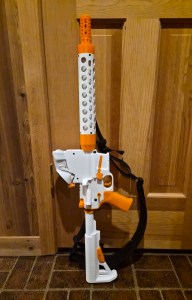
I recently had the opportunity to try out the JKVR-PCC from 71 Creative. What exactly is a JKVR-PCC? In simple terms, it’s a 3D-printed rifle platform designed around the ACE VR fire control unit, allowing you to practice drills, stage runs, and shooting fundamentals within the ACE VR ecosystem using a realistic rifle-style setup.
 If you’re unfamiliar with ACE VR, check out my review here. I’ve been using the system for nearly two years, logging more than 100,000 shots fired and over 7,000 completed drills. I train with it three to four times a week—sometimes for just 10–15 minutes, other times for closer to an hour. In fact, it’s the only reason I have a Quest 3 headset. I’m a complete believer in the system. Not only have I seen steady improvement in my performance, but I’ve also seen those gains translate directly to the limited live fire practice I’m able to do. ACE VR has been an absolute game changer for me, both as a training tool and as something I genuinely enjoy using.
What 71 Creative has accomplished with the JKVR-PCC is giving ACE VR users the ability to train with a rifle platform the same way they already train with pistols. More importantly—it works exceptionally well. That’s reassuring, because like ACE VR itself, the JKVR-PCC is not an inexpensive investment.
So who is 71 Creative? They’re a 3D-printing company specializing in firearm and range accessories, with a particular focus on ACE VR-compatible handsets. Want a realistic setup to replicate your competition pistol? They likely have an option for you.
My experience with 71 Creative has been excellent. Before purchasing the JKVR-PCC, I had several questions, and every response I received was fast, detailed, and helpful. That mattered to me because there’s very little information or user feedback available online, and the JKVR-PCC is a significant purchase.
Now that I’ve spent time with it, I can confidently say the JKVR-PCC is an impressively realistic reproduction of a pistol caliber carbine—or really any AR-pattern rifle. While I don’t regularly compete with PCCs, I do shoot AR-15s extensively, and the JKVR-PCC translates perfectly to that platform as well.
Here are the key features and options, taken directly from 71 Creative’s website:
- Compatible with real mil-spec handguards, grips, buffer tubes, and stocks
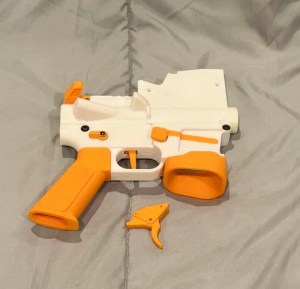
- Available with straight or curved trigger options
- Functional ambidextrous safety
- Competition-style trigger with approximately 2 lb pull weight (more on this later)
- MOE-style grip (compatible with real pistol grips)
- Two handguard options:
- Standard 12.5” round handguard
- Thin 9.75” hexagonal handguard
- Optional weighted configuration using lead shot encased in epoxy for realistic balance and feel
- Functional magwell, ambi safety, and magazine release designed around Glock magazines
- Multiple filament color options, including custom colors for an additional charge
One of the biggest strengths of the JKVR-PCC is the ability to customize it using the same furniture and accessories you run on your actual rifle. More importantly, it genuinely feels like a rifle. The weight, balance, ergonomics, and controls are all convincing enough that training with it quickly feels natural.
No, it doesn’t simulate recoil, and obviously no rounds are being fired. But as a dry-fire training tool, it’s remarkably effective.
Want to run Bill Drills at 25 yards? Practice target transitions? Move and navigate stages? The JKVR-PCC combined with ACE VR is about as close as you can get to meaningful rifle practice without stepping onto a live-fire range.
Pricing is where things become more complicated. The base JKVR-PCC starts at $185.99, but that configuration does not include a handguard, stock, or buffer tube. Adding those components increases the cost by roughly $70, and adding weighted components adds another $60. Fully configured, the rifle comes in around $315.99 before shipping. Custom colors cost extra as well, though personally I like the standard white-and-orange aesthetic since it matches the rest of my ACE VR equipment.
One of my initial concerns was immersion. ACE VR is fundamentally built around handgun tracking and visuals, so I wondered how awkward it would feel to physically shoulder a rifle while still technically using a pistol in-game. Surprisingly, 71 Creative solved this problem extremely well.
Inside ACE VR, the visual presentation shifts so that your pistol appears tucked close to your face, leaving only the optic and rear portion visible—very similar to a real rifle sight picture. In practice, it works brilliantly. After a few minutes, I stopped thinking about it entirely. I simply focused on targets, transitions, and shooting.
As a result, the JKVR-PCC allows for meaningful rifle-oriented practice within ACE VR. Low-ready presentations, target transitions, safety manipulation, movement, and even reloads with real Glock magazines all translate naturally.
That said, there are two major downsides worth discussing.
The first is cost—specifically the need for an ACE VR fire control unit. If you already own an ACE VR handgun setup, you technically have everything needed to run the JKVR-PCC. The fire control assembly can be swapped from your pistol handset into the rifle in just a few minutes.
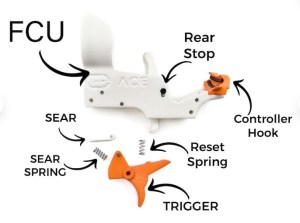 However, repeatedly swapping the unit back and forth quickly becomes tedious. The obvious solution is purchasing a second ACE VR handset solely to obtain another fire control unit. Problem solved—but at an additional cost of roughly $200.
Unfortunately, 71 Creative cannot simply include this component because the ACE VR fire control system is patented. The end result is that a fully optimized setup with dedicated pistol and rifle platforms can easily exceed $500.
That’s undeniably expensive for a dry-fire training tool. You could buy a real firearm for similar money, and it’s more than I pay annually in range fees at my local club. I was hesitant before purchasing it myself.
After using it, though, I can honestly say it has been worth every dollar. Much like ACE VR itself, the JKVR-PCC exceeded my expectations. If anything, I wish there were more products like this available.
The good news is that costs can be reduced significantly if you already own spare AR furniture. Using your own handguard, stock, and buffer tube lowers the price considerably, and skipping the weighted options or spare fire control unit can bring the total much closer to the $200 range.
My second criticism involves the trigger. While advertised as a “competition weight” trigger, in practice it feels extremely light and somewhat spongy. It has a defined wall, albeit very light and no tactile reset to speak of. Unless it closely mirrors the trigger in your real rifle, it can feel a bit artificial—and has little to offer from a training standpoint.
I’d love to see 71 Creative refine this aspect of the platform or offer alternative trigger options with more distinct feedback. ACE VR managed to create a surprisingly convincing trigger feel in their pistol handsets, so there’s definitely room for improvement here.
Even with that minor and largely subjective criticism, the JKVR-PCC remains an exceptionally well-designed training tool. 71 Creative has built a high-quality replica platform that genuinely enhances the ACE VR experience, especially for rifle shooters.
ACE VR is a company I’m happy to continue supporting, and I hope they keep innovating. The same goes for 71 Creative. Products like the JKVR-PCC make VR firearms training feel far less like a novelty and far more like a legitimate supplement to real-world practice.
Categories: Day at the Range, Firearm & Gear Reviews