Why fitness trackers, smartwatches, or heart-rate monitors at all?
You can consider this more of a philosophical discussion than a product review—though I’ll touch on specific aspects related to these modern technologies. According to Fortune Business Insights, the global fitness-tracker market was valued at 62 billion dollars in 2024. It’s expected to grow by another 10 billion in 2025 and could reach 290 billion by 2032. North America alone accounts for 42% of sales. The irony? Roughly 40% of Americans are considered obese. Are we trying to spend our way out of obesity?
A quick minute on Amazon is all it takes to see the sheer number of fitness tracker options—Amazon even sells its own. The choices feel endless. It’s estimated that anywhere between 5,000 and 20,000 distinct wearable fitness-tracking devices exist today.
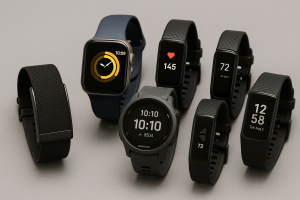 So why Whoop? Why Fitbit? Why Garmin? What’s behind this craze? What value do these devices actually provide—and are they making a difference?
For some people—generally athletes and active individuals—these devices provide real-time metrics that help guide workout implementation and evaluate training programs. Monitoring heart rate is the most common example. There’s little doubt these devices can effectively track intensity, volume, and even recovery to a degree. But how many users actually use the data? I would suggest very few, or at least a relatively small percentage of total users.
I’ve kept training journals for 35 years. Back then, they were essential for measuring progress: getting stronger, running faster, running farther. It’s fun—and sometimes depressing—to look back at them. I still keep written journals periodically, usually when returning to an activity after a layoff. They give me focus, motivation, and accountability. And really, those three reasons are why people keep buying fitness trackers.
After 30 years in the fitness industry, I can say with confidence that physical limitations rarely determine a person’s success. Focus (on effective training), motivation (to stay consistent), and accountability (to oneself or others) are far stronger predictors. So why do I pay Whoop $20 a month? Why am I wearing a Garmin Vivoactive on my left wrist—which I’ve used to track nearly all my workouts for years—and a Whoop band on my right? Because I need the focus, motivation, and accountability these devices provide. Will I need them all year? Probably not. This is my third round with Whoop. Will it be my last? I don’t know yet.
Does Whoop do something better than my Garmin?
Yes and no. They’re both capable of tracking similar information, though Garmin has been particularly useful for strength training—it lets me quickly time rest periods and stay on task. I keep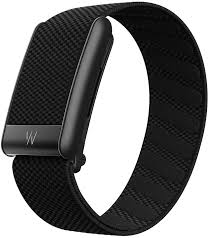 returning to Whoop because of its excellent interface, comfort, and ease of use. It does a great job of tracking overall health and well-being, especially sleep. Its sensors aren’t the most accurate in the industry, but they’re decent.
Whoop is designed less like a conventional smartwatch and more like a performance-and-recovery tracker. It focuses on three core metrics: Strain, Recovery, and Sleep. It continuously tracks heart rate, HRV, resting heart rate, respiratory rate, and sleep stages. There’s no screen—the companion app is where you view your analytics. Because it emphasizes readiness, it tells you how “prepared” your body is for exertion based on overnight data and will suggest rest or reduced strain when recovery is low.
If you care about training recovery, optimizing exertion vs. rest, improving sleep, and tracking readiness more than simply counting steps or calories, Whoop is compelling. If you want a device that provides real-time, on-wrist metrics (like a full multi-sport GPS watch), or if you’re budget-conscious, you might find better value elsewhere.
Whoop does a fair job of tracking activity, but it doesn’t present workout data in an easily accessible way without using your phone. Another long-standing weakness has been its ability to evaluate weight-training intensity—until recently, with the release of Whoop 5.0.
 Whoop 5.0 and Strength Training
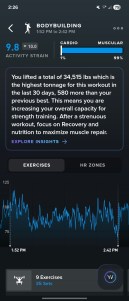
Whoop 5.0 tracks strength training by combining heart-rate data with motion patterns from its onboard sensors. It analyzes movement velocity, patterns (push, pull, hinge, squat), and the intensity of each rep. It also considers how your heart rate recovers between sets. Using all of this, Whoop generates a Muscle Load score that contributes to your daily Strain and Recovery metrics.
The result is a Strain score that finally aligns with perceived intensity during vigorous strength workouts. That intense deadlift and squat session is no longer scored as half the strain of an easy three-mile run. It’s not perfect, though. Exercises generally need to be added after the workout, though saved routines help reduce the hassle. Personally, I find this new feature effective, and with a bit more refinement, it could become one of Whoop’s strongest selling points.
The Problem: Recent Anomalies
If I had finished this article a couple of weeks ago, I might have given Whoop a stronger endorsement. But recently I began getting very anomalous readings: unusually high resting heart rates, absurdly high HRV, and workout metrics that made no sense. The readings were obviously wrong. My frustration eventually led me to take the band off for several days. When I put it back on, the numbers had normalized somewhat but were still off—now presenting lower-than-usual resting heart rates and slightly elevated HRV.
Normally these would indicate good recovery—“Green” scores. Instead, Whoop began comparing them to the earlier flawed data. The result: nearly a week of “Red” recovery scores. So what’s going on? Was Whoop wrong for months? Did a software update change the algorithm? I don’t know—but I’ve lost a significant amount of trust in the device. Not long ago I was telling other Whoop users how consistent and insightful the data felt. I thought I’d use it indefinitely. Now I’m considering taking it off for good.
The Bigger Picture
The truth is that all of these devices share similar weaknesses. They interpret data differently, use different sensors, and vary in accuracy. They’re tools—useful tools—as long as you accept their limitations. If you’re an athlete who requires accurate, real-time metrics to track and adjust your training, a traditional chest-strap heart-rate monitor is still king. If you’re simply looking for focus, motivation, and accountability, there are many solid wearable fitness tracker options out there.
Categories: Fitness & Health












 Guns, Gear & Guy Stuff