
I was a proud papa this past Tuesday as I watched my 9-year-old daughter take her first Taekwondo class. I literally couldn’t stop smiling as I watched the instructor teach her the basics—her first kicks and punches. Having studied Taekwondo myself for more than a decade and having been an instructor for several of those years, the nostalgia was almost overwhelming. I would have happily donned a uniform, tied on a white belt, and started that journey anew with her. In fact, I’m still considering it, if my schedule allows.
I started my martial arts journey at around the same age she is now, and those years were formative and deeply influential in shaping who I am today. Taekwondo challenged me physically, but more importantly, it fostered mental fortitude and discipline. And this is where I worry that the value of traditional martial arts has been overshadowed by the prevalence and popularity of combat sports.
Mixed Martial Arts (MMA) in particular has completely changed people’s perception and attitude toward traditional martial arts. Don’t get me wrong—MMA represents the next evolution of martial arts, at least from the standpoint of its “martial” aspect. Many in the martial arts world would agree that Bruce Lee himself helped pave the way for modern combat sports. He is famously quoted as saying, “Absorb what is useful, discard what is not.” Few would argue that learning a traditional kata or form (or poomsae, in Taekwondo) has much real-world application in a fight. In Enter the Dragon, Bruce Lee famously says, “Boards don’t hit back,” which begs the question: What’s the point of practicing such things in traditional martial arts?
You may have noticed that I refer to MMA as a “combat sport” rather than a “martial art.” That’s because its practice and execution align much more closely with modern sports than with traditional martial arts. The word art can be defined as the expression or application of human creative skill and imagination, producing works to be appreciated for their beauty, emotional power, and technical proficiency. There’s an expression, “art for art’s sake,” meaning that art doesn’t need to serve a purpose beyond itself.
In my daughter’s first class, the instructor posed a question: “Why do we practice Taekwondo?” Many would assume the answer is self-defense. “But that is not so,” he said. “We practice Taekwondo to strengthen the body and discipline the mind.” The art of traditional martial arts is the outward expression of that journey.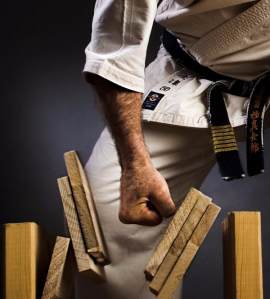
So why perform a kata? Because it is an expression of skill and technique, grounded in discipline and perseverance. Why break a board? Because it is an expression of focus and self-confidence.
Are traditional martial arts dead? I hope not, and I don’t think so. The most important lessons my daughter is learning right now are respect and self-confidence. It brings a smile to my face when I hear the instructor remind her to say, “Yes, sir” when responding to him. When I see her bow to the flag at the beginning and end of class, it fills me with pride. When I hear her Kihap—her yell—while performing a technique, I know she is pushing past her comfort zone. I know she is nervous, but I also know these are the steps toward becoming a confident and powerful young woman.
If I had my way, everyone would start their martial journey with traditional martial arts. It provides an excellent physical and technical foundation while honing the mind to meet the greatest challenge we all face—ourselves.
Categories: Random Rants & Philosophizing










 Guns, Gear & Guy Stuff