
I can’t remember where I first encountered the ACE virtual shooting simulator, but I do know I was instantly intrigued. I quickly began searching for more information, reviews, and eventually researched the Meta Quest headset. After gathering that initial info and watching a few early reviews, I was sold – I knew I had to have it!
At the time, there weren’t many comprehensive reviews available, and the few I found didn’t answer all my questions. Most were just brief game play snippets, but it was enough to push me to take the leap. I have been thinking about writing a review for some time. I was truly inspired though after watching a video on YouTube by gentleman whose channel is called Controlled Pairs. He does a phenomenal job of demonstrating ACE’s utility as a firearms trainer. In particular, beginning around the 20 minute mark, he directly compares some real world USPSA Classifier events with their virtual counterparts in the ACE system. His comparison does an absolutely awesome job of showing the true utility of the ACE system. I highly recommend watching the linked video and subscribing to his channel.
So, what exactly is ACE? Is it a game, or is it a training simulator?
The ACE website describes itself as: “Your Own Personal VR Shooting Simulator.” It’s an entirely fair description and as you can see from Controlled Pairs videos, it can do a fantastic job of simulating quite accurately a real-world shooting competition.
As of now, I’ve fired over 50,000 rounds using ACE and logged many hours. According to the app, I’ve saved over $16,000. The Meta Quest 3 headset itself has proven valuable, not just for ACE, but for other games and media consumption as well. Even my kids, who are quite young, enjoy using it occasionally. But for me, ACE is the main draw – I use the app almost exclusively. In fact, for all intents and purposes, I purchased the Meta Quest 3 just for shooting practice.
Along with the subscription fee, there’s the additional cost of the handset (the replica firearm the Quest controller fits into), which brings the initial investment to around $233 ($19 for the first month, $199 for the handset, and $15 for shipping). Add in the Meta Quest 3 itself, which was about $650 when I bought it, and you’re looking at a significant upfront cost. I could have gone cheaper – I could’ve purchased the Meta Quest 2 or the 128 GB version of the Quest 3 and saved hundreds. But part of the justification was the headset’s broader potential, and that value was a key factor in my decision.
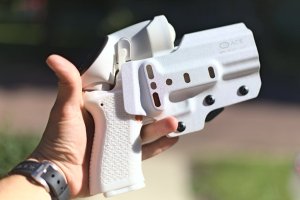 After purchasing the holster that ACE recently released, my total initial investment has reached nearly $1,000. That might sound extreme to some, but I suspect many gun owners reading this might have firearms in their safes that cost upwards of $700, $800, or even $1,000 – that rarely see the light of day. I know I do. I’ve also spent hundreds of dollars on other dry-fire practice products, such as Mantis systems, bore lasers in various calibers, and even an airsoft replica of my Glock 17. While all of those have value, nothing has felt as immersive or potentially beneficial as the ACE XR system.
I say “potentially beneficial” because it’s still too early to determine how well ACE translates to real-world shooting. But for now, ACE provides me with the ability to:
- Practice anywhere: This is a game changer. I can practice almost anywhere. In fact, I often practice at work in my private office, where I can lock the door and spend 20-30 minutes on shooting drills. My office is small, so I can’t do much movement, but I can still work on plenty of shooting drills. For drills that require some movement, my basement (with the furniture pushed aside) provides space for many of those exercises. Lastly, my backyard offers more than enough room for drills that demand substantial movement.
- Practice cheaply: This is one of ACE’s most underappreciated benefits. If I had the time and resources to practice with live fire as much as I do with ACE, it would be prohibitively expensive. With ACE, I can practice as much as I want without the significant costs of ammo, range fees, or travel.
- Practice things I can’t do otherwise: This is the most valuable aspect of the ACE system for me. Many of the drills ACE allows me to practice simply aren’t feasible unless I’m participating in an actual match, which I only do once or twice a year. My private shooting club is fantastic, but it doesn’t have the facilities for this type of practice. ACE bridges the gap between refining my fundamentals and applying them in real-world match conditions. After every match or even after completing a stage, I often wish I had a way to keep practicing those specific skills. ACE gives me that ability.
That said, there are some potential pitfalls to consider with the ACE shooting simulator. Most notably, it can lead to developing bad habits, especially for beginners. ACE’s two greatest strengths – practicing anywhere and cheaply – can result in counterproductive results. If you’re executing poor form or incorrect fundamentals, you may ingrain bad habits and muscle memory that can be hard to break. Additionally, ACE can’t simulate recoil, which is a critical component of the learning process when using a real firearm.
I’ve seen examples, especially when demonstrating ACE to friends or family, where someone with no shooting experience can appear proficient in the simulation despite using poor form or improper techniques. ACE doesn’t penalize for things like a loose grip, improper firearm stance, or incorrect arm positioning. However, the recoil of real firearms will quickly reveal these mistakes.
Because of these risks, I’d recommend that only individuals with a solid understanding of firearm fundamentals use ACE for serious practice. While ACE could be used as a “game” by a broader audience, given its upfront cost and monthly subscription, it’s unlikely to appeal to casual gamers.
Categories: Day at the Range, Firearm & Gear Reviews










 Guns, Gear & Guy Stuff